
You’ll know it’s time to upgrade when your GPU hits 100 % usage while the CPU idles, FPS stalls around 30, and you see stutters or visual artifacts in demanding scenes. If benchmarks fall well below online averages, thermal throttling or aging hardware is likely the cause. Aim for at least a 10‑15 % FPS lift, a balanced VRAM size (12‑16 GB for 1440p/4K), and a PSU that can handle the new card’s draw. Choosing a one‑tier jump (e.g., 3060 → 3070) gives a solid boost without massive extra cost, while a generational jump (3060 → 4080) offers future‑proof performance if you can afford the higher wattage and cooling. Timing your purchase around sales or new‑gen releases can further improve cost‑to‑performance. Keep an eye on temperature and power stability during testing, and you’ll see consistent gains across real‑world and synthetic benchmarks. If you stick with these steps, you’ll discover exactly how to validate the upgrade’s impact.
Identify GPU‑Performance Symptoms
Ever notice your games lagging at 30 FPS or lower even after you dial down settings? You’re probably facing a GPU bottleneck. When the graphics card hits 100% utilization while the CPU idles, the frame rate stalls and you feel a stutter that ruins smooth gameplay. Look for consistent low FPS around 30 or less, sudden pauses, or visual artifacts during demanding scenes. Older titles may only run acceptably at reduced settings, hinting that the hardware is aging. If your benchmark scores fall far below online averages for the same GPU model, thermal throttling or hardware failure could be the cause. Spotting these symptoms early lets you decide whether a repair, cooling fix, or a full upgrade is the right move. Upgrading to a card with a balanced memory bandwidth and a PCIe 5.0 capable design can offer a future-proof improvement memory bandwidth and overall performance.
Measure Real‑World FPS for a GPU Upgrade
Turn on an in‑game or launcher FPS counter and note the average frame rate at your usual settings to set a baseline. If you see a steady 30 FPS or lower across several titles, that points to a GPU bottleneck worth fixing. Compare those numbers with benchmark tools like MSI Afterburner to see how much real‑world FPS you’ll actually gain after the upgrade. Also, consider checking for high‑density acoustic foam panels to manage room acoustics during long gaming sessions acoustic foam panels and ensure a comfortable, distraction‑free environment while you test new hardware.
Counter FPS Benchmarks
How can you tell if a GPU upgrade truly boosts your gaming experience? You start with FPS benchmarks that capture real‑world frame rate during typical play, not synthetic scores. Run the same titles at your usual settings before and after the upgrade, using in‑game or launcher counters. Record the average FPS for each session and compare the numbers. If your pre‑upgrade average hovers around 30 FPS or lower across several games, you’re likely hitting a bottleneck that the new GPU can relieve. After the upgrade, look for a consistent lift—say 15‑20 FPS higher—while keeping the workload identical. Cross‑check your gains against online model averages to confirm they exceed normal variance and truly reflect the upgrade’s impact. Bias Lighting can also influence perceived comfort and clarity during testing, so ensure your test environment’s lighting remains consistent to avoid skewed results.
In‑Game FPS Variability
Why settle for a single average FPS number when the real story lies in its spikes and dips? You need to track FPS variability in‑game to see how your GPU handles real‑world loads. Use the launcher’s FPS counter at typical settings, note any frame‑time spikes, and compare the curve to online model averages for your card. If you see consistent 30 FPS or lower, a GPU bottleneck is likely, and an upgrade will lift both average and peak performance. High or Ultra settings on newer titles demand a newer GPU to keep in‑game performance above 60 FPS; otherwise you’ll be forced to drop to Low or Moderate. Spotting large frame‑time spikes tells you whether the hardware is keeping up or lagging behind expectations. Latency Considerations for Mobile Gaming
Benchmark Your GPU Upgrade Against Model Averages
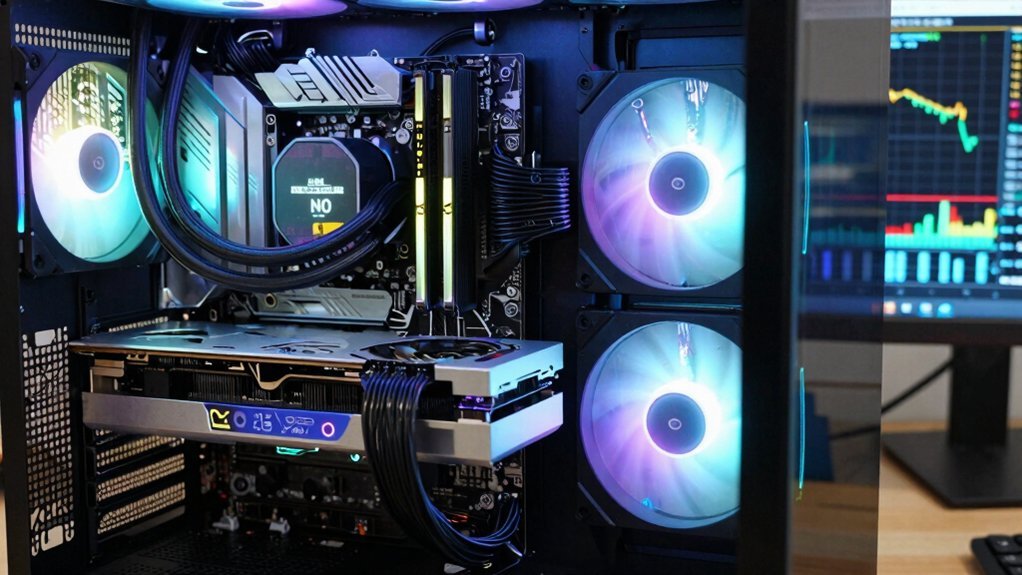
Ever wondered if your new GPU lives up to the hype? You can Benchmark its performance by running a simple FPS test and scene‑render timer, then compare those numbers to online model averages for the same GPU. If your scores lag, thermal throttling or hardware wear might be the culprit. Consistently higher frame rates across several benchmarks prove your upgrade is delivering real‑world gains, even if raw scores don’t hit every game’s peak demand. You can optimize your setup by ensuring proper power delivery and cooling, which are essential for sustained performance thermal management.
Fault vs. Age: Interpreting Low Scores
When your benchmarks dip, ask whether the drop matches the typical age‑related decline or spikes like a fault. If the scores fall well below model averages and you see artifacts or crashes, a hardware issue is likely. Consistent, modest loss across tests points to natural aging, while sudden, severe dips suggest a specific problem.
Benchmark Scores vs. Age
Do benchmark scores really reflect a GPU’s age, or could they be signaling a fault? You notice the numbers slipping as the card ages, but the drop isn’t always linear. When benchmark scores dip modestly over years, it’s usually just performance decline from wear and newer game demands. However, a sharp plunge below online averages often points to thermal throttling or hardware degradation, not just age. Compare your current scores to historical trends; if they fall gradually, your upgrade decision can wait. If they plunge, you may need to replace the card now to keep pace with modern titles. Budget storage principles can help you plan affordable upgrades and organize components without overspending.
- Frustration – watching favorite games stutter.
- Anxiety – wondering if the card is failing.
- Relief – realizing age, a score drop.
- Motivation – deciding whether to upgrade.
Low Scores: Fault Indicators
If your benchmark scores have slipped well below the online averages for the same GPU, it’s likely more than just age. You’re probably seeing GPU throttling, driver issues, or hardware degradation. When a card hits near‑100% utilization yet delivers low FPS, the bottleneck isn’t the game; it’s the hardware. Persistent artifacts, crashes, or stuttering after a fresh driver install point to a failing GPU rather than normal wear. Recognizing these signs helps you decide whether to troubleshoot, replace, or upgrade before the card becomes a liability. Integrated charging station can help organize power connections and reduce cable clutter during diagnostics.
Calculate Cost‑to‑Performance for GPU Upgrade Paths
Although a GPU upgrade can feel tempting, you’ll only get value out of it when the performance boost outweighs the total cost. Start by checking benchmarks on your favorite titles; a 10 % FPS lift is the minimum for a worthwhile cost‑to‑performance ratio. Next, compare the age gap: a 5‑year‑old card usually delivers larger absolute gains than a 2‑year‑old model that costs more. Then, factor in ancillary expenses—new power supply, case clearance, or motherboard adapters—because they erode the net benefit. Finally, confirm the upgrade actually eliminates the bottleneck; if the system is CPU‑bound, even a powerful GPU won’t improve frame rates.
- Benchmarks: real‑world FPS gains
- Age gap: older cards = bigger jumps
- Ancillary costs: PSU, case, motherboard
- Bottleneck check: GPU‑bound vs. CPU‑bound
Determine Needed VRAM for Future GPU Upgrades
You’ll want to match your VRAM to the resolution you plan to game at—8 GB works for 1080p, but 12‑16 GB becomes essential for 1440p and 4K.
Think ahead to upcoming titles that push texture sizes and use AI upscalers; aiming for at least 12‑16 GB gives you a safety net.
Also, consider the memory bus width and speed, because even with plenty of VRAM you need bandwidth to keep high‑resolution textures flowing smoothly.
VRAM Requirements by Resolution
So much VRAM do you actually need for your next GPU? If you game at 1080p, 6‑8 GB usually covers most titles, but stepping up to 1440p pushes you into the 8‑12 GB range, especially when you crank texture quality and bandwidth. For 4K, aim for 12‑24 GB; modern games can hit 10‑12 GB even at 1440p, and ray‑tracing or AI upscaling adds extra buffers. Remember, beyond 16 GB the gains fade unless you chase extreme texture packs or mods. Planning for 1‑2× the game’s texture footprint gives you headroom for future patches and higher settings.
- 1080p → 6‑8 GB – solid baseline
- 1440p → 8‑12 GB – texture‑heavy safety net
- 4K → 12‑24 GB – high‑resolution luxury
- 16 GB+ → diminishing returns – only for ultra‑future titles
VRAM Planning for Future Titles
How much VRAM will your next GPU need to stay relevant? You’ll want at least 12‑16 GB if you aim for 4K gaming and want headroom for future titles. Modern 1080p titles run fine on 8 GB, but 1440p at high settings already pushes 8‑12 GB, and ray tracing or DLSS/FSR can spike usage. Plan for a 2‑4 GB buffer beyond today’s demands; a 16 GB card gives you a safe baseline across two to four generations. Don’t forget memory bandwidth—high bandwidth pairs with ample VRAM to keep the GPU from throttling under heavy textures or AI upscaling. By balancing VRAM size and bandwidth, you’ll protect performance as games adopt higher‑resolution assets and more aggressive rendering techniques.
Match GPU Upgrade to CPU, RAM, and PSU Specs
A successful GPU upgrade starts with confirming that your power supply and motherboard can handle the new card’s power draw and PCIe slot requirements. First, double‑check the PSU wattage and connector count; a weak PSU will instantly bottleneck the GPU and crash your system.
Next, verify the CPU can keep pace—if the CPU stalls at 70% while the GPU hits 100%, performance stalls.
Then, ensure your RAM capacity and speed match the GPU’s VRAM bandwidth; insufficient RAM creates data starvation.
Finally, run a real‑world benchmark to see FPS gains and spot any lingering bottlenecks before you invest in cooling or case upgrades.
- Power – Confirm PSU rating and connectors.
- Processor – Match CPU to GPU demand.
- Memory – Align RAM speed and size with GPU VRAM.
- Testing – Validate performance with real‑world workloads.
Choose One‑Tier vs. Generational GPU Upgrade
Wondering whether to stick with a one‑tier upgrade or jump an entire generation? If you’re eyeing a 3060‑to‑3070 swap, expect a 20‑40 % FPS boost for a modest cost. That one‑tier upgrade leans on higher clocks and extra cores, fitting into your existing PSU and case without hassle.
A generational upgrade—say, 3060 to 4080—delivers 2‑3× performance gains, newer ray‑tracing hardware, larger VRAM, and DLSS/FSR refinements, but it often demands a higher‑wattage PSU, better cooling, and possible motherboard tweaks.
Choose a one‑tier upgrade when your budget’s tight and you need a quick lift. Reserve a generational upgrade for long‑term future‑proofing and when you crave the latest architectural features.
What Ray‑Tracing & AI Upscaling Add to Your Upgrade?
Ever wondered why a modern GPU feels dramatically smoother when ray‑tracing and AI upscaling are enabled? Those features let you chase cinematic lighting and 4K‑sharp images without sacrificing frame rates. Ray tracing adds realistic reflections and shadows, but it taxes the GPU’s compute units and VRAM. AI upscaling—through DLSS/FSR—renders at a lower resolution, then intelligently reconstructs detail, often delivering 1.5×–2.5× performance boosts. When you pair dedicated RT cores with AI accelerators, the visual leap feels tangible, and the extra VRAM (12 GB+) keeps high‑resolution textures from choking the system.
Ray tracing and AI upscaling combine for cinematic 4K visuals, delivering smoother frames and efficient VRAM usage.
- Immersive realism – lighting that reacts like real life.
- Higher FPS – smoother gameplay at 4K.
- Efficient memory use – VRAM requirements stay manageable.
- Future‑proof performance – ready for next‑gen titles.
Best Times to Purchase a GPU Upgrade
When should you actually buy a new GPU? You should target upgrade timing when FPS drops noticeably or when a >10 % performance boost would meaningfully speed up games or workflows. Watch for a system bottleneck that shifts from CPU‑bound to GPU‑bound—those moments signal it’s time. If your card is five years old or more, you’ll likely see dramatic gains; a 2‑year‑old model may only offer modest improvements for the cost. Check that your power supply can handle the new draw and that the card fits your case. Align the purchase with sales events, product launches, or when stock clears older generations. This approach maximizes GPU performance while keeping expenses in check.
Install and Test Your New GPU Upgrade
Ready to get the most out of your new GPU? Boot into your OS, then grab the latest drivers from NVIDIA or AMD. Fresh drivers release power, performance, and feature support, so you’re ready for accurate performance testing. Next, launch your favorite games or workloads and record FPS, frame times, and any stutter. Compare those numbers with your pre‑upgrade baseline to see the real impact. Keep an eye on GPU usage and temperatures with MSI Afterburner or Task Manager; you want usage near 100 % without thermal throttling. Finally, hunt for bottlenecks—make sure CPU, RAM, storage, and PSU aren’t holding you back.
- Install drivers, feel the surge.
- Run real‑world tests, watch the FPS climb.
- Monitor usage, avoid overheating.
- Eliminate bottlenecks, unleash full power.
Validate Performance Gains After the Upgrade
Once you’ve got the drivers installed and the initial tests running, it’s time to verify that the new GPU actually delivers the promised boost. Run the same games and workloads at identical settings, record FPS and frame times, and compare them side‑by‑side. Use in‑game counters or overlay tools to catch a measurable uplift—aim for at least a 10 % jump. Watch GPU usage and CPU usage during benchmarks; the upgraded card should hit higher GPU usage while CPU usage stays steady, indicating the bottleneck shifted. Run synthetic benchmarks and real‑world tasks to confirm performance gains translate across scenarios, and keep an eye on thermal and power stability for fewer crashes and lower temperatures.
| Metric | Before Upgrade | After Upgrade |
|---|---|---|
| FPS | 85 | 98 |
| GPU usage | 68 % | 94 % |
| CPU usage | 55 % | 53 % |
| Temperature (°C) | 78 | 71 |
Frequently Asked Questions
Will Upgrading Graphics Card Improve Performance?
Yes, you’ll see a performance boost if your current GPU is the bottleneck, but only when your CPU, RAM, and power supply can keep up; otherwise gains will be minimal.
Are GPU Prices Going Down in 2026?
Yes, GPU prices are generally trending downward in 2026, especially for mid‑range and refurbished models, as new releases push older cards into 10‑30 % discounts across most market segments.
When to Upgrade Your Graphics Card?
You should upgrade when you see persistent low FPS or stuttering, the GPU hits near‑100% while the CPU stays idle, and you need features like ray tracing or 4K support that your current card lacks.
Is 90% GPU Usage Bad?
You’re not necessarily in trouble—90% usage just shows the GPU’s working hard. It becomes bad if temperatures climb, throttling occurs, or FPS stays low despite the load.
In Summary
Now you’ve pinpointed the bottlenecks, measured real‑world FPS, and weighted cost against performance, you can confidently choose the GPU that actually upgrades your experience. Ray‑tracing and AI upscaling will boost visuals without breaking the bank, and timing your purchase maximizes savings. Install, test, and verify the gains—then enjoy smoother, faster gaming that truly matches your budget and expectations.


Leave a Reply