
Skipping every other GPU generation lets you dodge premium price tags for only modest performance bumps, stretching the value of your current card. You’ll avoid paying inflated MSRP, reduce upgrade‑cycle costs, and give yourself more time to reap real‑world gains like higher VRAM or ray‑tracing support. By timing purchases around market troughs and using iGPU‑assisted lossless scaling, you can keep performance up without splurging. Continue, and you’ll discover how to fine‑tune this strategy for maximum savings.
Decide If Skipping a GPU Generation Saves Money
Should you skip a GPU generation to save money? You weigh price‑per‑performance against the upgrade cycle, asking whether the next card’s value justifies its cost. If a new model drops dramatically in price or a current one is scarce, you might extend your waiting period. High‑end jumps—say from a GTX 980 to an RTX 7900 XT—only make sense when the performance boost matches your budget and gaming needs. Availability glitches, like the 2070 Super shortage, can lengthen the gap between purchases, improving the cost‑benefit of skipping. Ultimately, you decide by comparing the incremental performance you’ll actually use with the total expense, ensuring the chosen generation delivers the best value for your money. In some cases, monitoring price trends and live market values can help determine when the next drop offers genuine value.
Skip GPU Generation: 2‑Year vs. 4‑Year Cost‑Benefit Comparison
How long should you wait before swapping out your GPU—two years or four? Your upgrade cadence hinges on cost‑benefit, market timing, and how quickly a new graphics card lifts performance. A 2‑year cycle can feel tempting when games demand more VRAM and ray tracing, but price inflation and diminishing returns often shrink the payoff window. A 4‑year gap usually aligns with budget cycles, allowing you to amortize higher MSRP, PSU upgrades, and energy costs. Supply shocks—like the 2070 Super’s two‑year scarcity—can compress the 2‑year benefit, forcing earlier purchases. Weigh the following:
- Immediate performance boost vs. long‑term savings
- MSRP inflation vs. resale value
- Platform upgrade costs vs. stability
- Market timing pressure vs. planned budget cycle upfront cost dynamics
Using iGPU‑Assisted Lossless Scaling to Extend Your Upgrade Cycle
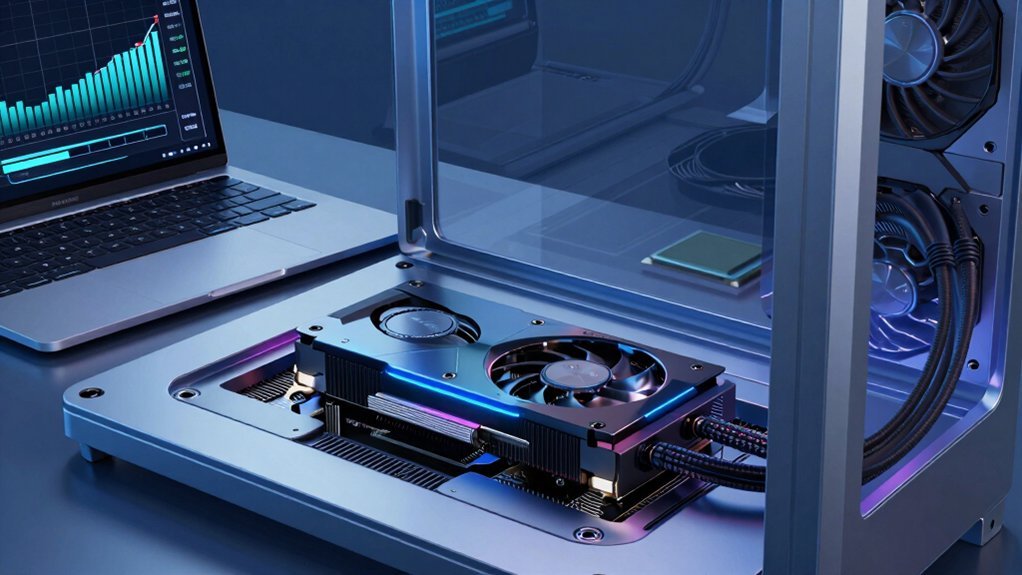
Why not squeeze more life out of your current rig by letting the integrated GPU share the workload? Enable the iGPU in BIOS, confirm Windows sees two adapters, then set each app to use Lossless Scaling with the iGPU as a secondary processor. This dual‑GPU arrangement offloads frame generation, letting your RTX 5070 focus on heavy rendering while the iGPU handles scaling. At $7 on Steam, the test is cheap and works across games and video, extending your upgrade cycle without a new card. Watch for latency or artifacts if the iGPU struggles at high resolutions, and tweak performance settings accordingly. With proper configuration, you keep performance high and postpone costly GPU purchases. This approach also benefits systems with budget SSDs by avoiding unnecessary storage bottlenecks during higher-resolution workloads hardware integration and can help maintain smooth gaming experiences while you plan future upgrades.
Schedule Your GPU Purchases for Maximum Savings
If you time your GPU purchases around market cycles, you can stretch each card’s value for years. You’ll notice that pricing spikes after a new launch, then settles roughly four years later, making that window ideal for savings. By aligning upgrades with these troughs, you avoid paying premium prices for marginal performance gains. XMP/DOCP/EXPO profiles can help you realize the advertised speeds on compatible systems and thus maximize value during these down periods.
Frequently Asked Questions
What GPU Does Elon Musk Use?
You’ll find Musk’s rigs running Nvidia RTX 4090‑class GPUs, often paired with high‑end CPUs and massive RAM. He upgrades frequently, so the exact model may shift, but the 4090 series dominates his current setup.
Why Is There a 5090 Shortage?
You’re seeing a 5090 shortage because Nvidia’s focusing on lower‑VRAM GPUs to cope with memory supply constraints, delaying RTX 60 production and limiting overall high‑end inventory.
Did Ryzen Skip the 8000 Series?
You didn’t miss anything—AMD released the Ryzen 8000 series, continuing the 7000 line with new Zen architecture, higher IPC, and DDR5 support, so the generation wasn’t skipped at all.
Why Don’t People Use Two GPUS Anymore?
You stop using two GPUs because scaling performance costs more than single‑GPU gains, power and cooling limits rise, drivers and software favor one card, and newer GPUs already deliver enough throughput for most tasks.
In Summary
By weighing the cost‑benefit of a 2‑year versus a 4‑year upgrade cycle, you’ll see that skipping a GPU generation can slash expenses without sacrificing performance—especially when you pair it with iGPU‑assisted lossless scaling. Timing your purchases to align with price drops and leveraging existing hardware lets you stretch each investment further. In short, strategic skips and smart scaling keep your budget tight while your compute power stays ahead.


