
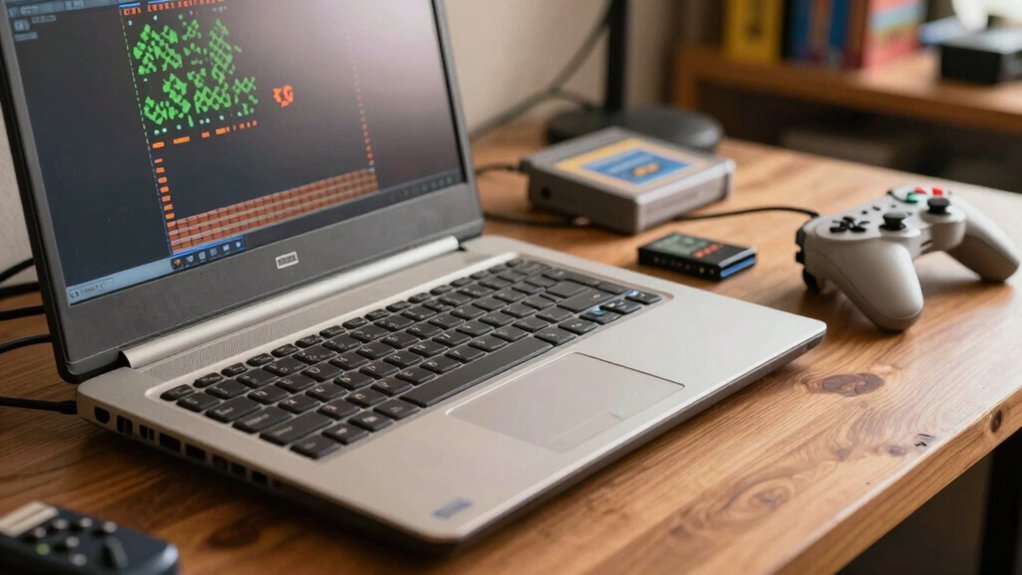
You’ll want a mid‑range i5 or Ryzen 5 so classic titles run without hitch, paired with an older GeForce 600‑800 or Radeon GPU that still offers hardware acceleration. Upgradeable 8‑16 GB RAM keeps emulators responsive, while a PCIe Gen4/5 SSD slashes load times and a 1080p screen with 300 nits displays pixel art clearly. Solid I/O—multiple USB‑A ports, HDMI/DisplayPort, and an SD reader—ensures you can hook up peripherals and external displays. Stick around and you’ll discover how each spec ties together for smooth, future‑proof retro gaming.
Cheap Retro Gaming Laptop CPU, GPU, and RAM Minimums
What should you look for in a cheap retro gaming laptop’s CPU, GPU, and RAM? You need a mid‑range CPU—think Intel i5 or AMD Ryzen 3/5—so classic titles run without hitch. Pair it with a dedicated GPU from the GeForce 600/700/800 series or an equivalent Radeon; older games still benefit from hardware acceleration. Aim for 8–16 GB of RAM, enough to handle modern OS overlays while keeping the system responsive. Choose a budget‑laptop that lets you upgrade RAM or the GPU later, avoiding soldered‑only configurations that lock you out of future tweaks. Verify the CPU architecture and PCIe generation support the GPU drivers you’ll need. This balance gives you smooth performance without breaking the bank. DPI Ranges and Customization
Best SSD, Display, and I/O Options for Cheap Retro Gaming Laptops
After locking down a capable CPU, GPU, and enough RAM, the next step is to sort out storage, screen, and connectivity. Choose an SSD of 512 GB–1 TB with PCIe Gen4/Gen5 support; the fast reads cut load times and give you room for dozens of classic titles. Pair it with a 1080p display that hits at least 300 nits; crisp pixels and decent brightness keep pixel art and UI elements clear, even on older games. Prioritize I/O options like three USB‑A ports, an HDMI or DisplayPort, and an SD‑card reader for quick game transfers. Finally, make sure the laptop offers upgradeable RAM—ideally 16 GB—so you can boost memory later without swapping the whole machine. Upgradeable RAM provides a straightforward path to future-proofing without replacing the chassis.
Spot Quality Used Cheap Retro Gaming Laptops
Looking for a used laptop that won’t break the bank yet still handles retro emulation smoothly? Focus on models that ship with 16–32 GB RAM and a clear upgrade path, because extra memory keeps older emulators snappy. Prioritize a mid‑range i5/i7 or Ryzen 5/7 CPU to balance power draw and performance, and make sure the machine sports a PCIe SSD—ideally 1 TB or a 512 GB drive you can swap later. Check the cooling system; adequate fans and heat‑pipes prevent throttling during long gaming sessions. Avoid soldered‑RAM units and verify driver support before you buy. A robust protection strategy to guard the upgrade path and future compatibility GaN is beneficial for maintaining safe charging and device longevity.
| Brand | Key Spec | Why It Matters |
|---|---|---|
| Dell Latitude | 16 GB RAM, upgradeable, PCIe SSD 1 TB | Strong upgradeability, fast storage |
| Lenovo ThinkPad | 32 GB RAM (upgradeable), PCIe SSD 512 GB | High RAM, easy expansion |
| HP EliteBook | 16 GB RAM, PCIe SSD 1 TB, robust cooling | Prevents throttling, ample space |
Frequently Asked Questions
Is 32GB RAM Overkill for a Gaming Laptop?
Yes, 32 GB is usually overkill for a gaming laptop; you’ll see negligible performance gains over 16 GB in most titles. Stick with 16 GB, prioritize upgradeable slots, and choose faster RAM if you can.
Is 64 GB of RAM Overkill for a Laptop?
You’ll find 64 GB overkill for most laptops; unless you run heavy VMs, large datasets, or extreme multitasking, 16‑32 GB comfortably handles games, emulation, and everyday tasks.
Is a $600 Dollar Gaming PC Good?
You’ll find a $600 gaming PC decent for retro and light indie titles; it handles 1080p with modest settings, especially if you prioritize a used GPU, 16 GB RAM, and an SSD.
What Specifications Are Needed for a Gaming Laptop?
You need a modern i5/i7 or Ryzen 5/7 CPU, a dedicated GPU, at least 16 GB RAM (upgradeable), a 512 GB‑1 TB NVMe SSD, a 1080p ≥120 Hz display, and solid cooling with reliable power delivery.
In Summary
You’ve seen the specs that keep retro games running smoothly without breaking the bank. By targeting a modest CPU, a low‑end GPU, and enough RAM, you’ll get reliable performance. Pair that with a fast SSD, a decent display, and solid I/O, and you’ll have a portable arcade that fits your budget. Hunt for well‑maintained used models, and you’ll be gaming classic titles wherever you go.


Leave a Reply