

You’ll notice a 550 W PSU gives you roughly a 20 % headroom over a 450 W unit, keeping most gaming rigs under 70 % load and letting them sit near their peak 80 Plus Gold or Platinum efficiency curves, whereas a 450 W supply often runs closer to its upper limit, especially with higher‑end GPUs, which can push efficiency down and leave less room for future upgrades. The extra wattage also spreads the load across a broader range, so you’ll see steadier efficiency and better rail stability. Keep going and you’ll discover how these differences affect cost and future‑proofing.
450W vs 550W PSU: Which One Fits Your Build?
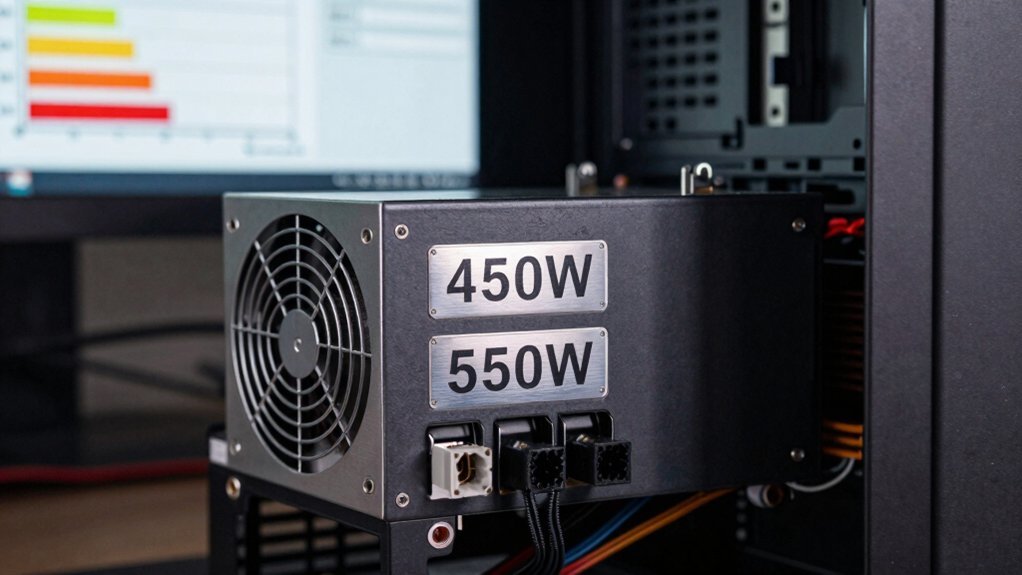
Wondering whether a 450W or a 550W PSU is right for your build? You’ll balance Power and Efficiency against your current components and future upgrades.
A 450W unit fits modest rigs, but its limited headroom can strain the PSU if you add a higher‑end GPU or overclock.
The 550W model offers extra wattage, giving you a comfortable margin for mid‑range gaming or workstation parts, and it eases the load when you upgrade later.
Both can meet the same 80 Plus certification, so efficiency at typical loads stays comparable.
Check the number of PCIe connectors, case space, and your upgrade roadmap; a 20 % overprovisioning buffer—roughly 450 W for a 360 W load—helps avoid bottlenecks and protects long‑term performance.
Typical Gaming Loads for 450W and 550W Systems
How much power does your gaming rig actually draw? In mid‑range gaming you’ll typically see a 450W PSU operating at 60‑80 % load, while a 550W unit sits around 40‑70 % load for the same hardware. Those load percentages line up with efficiency curves, so the 450W may hit its sweet spot earlier than the 550W. You gain headroom with the larger wattage, which eases transient spikes and future upgrades. Real‑world performance hinges more on power supply tier and component quality than raw wattage, but choosing a unit that matches your load improves both efficiency and noise.
| System | Approx. Load (W) | Load % |
|---|---|---|
| 450W + mid‑range GPU/CPU | 329 | 73 % |
| 550W + same hardware | 329 | 60 % |
| 450W + higher‑end GPU | 380 | 84 % |
| 550W + higher‑end GPU | 380 | 69 % |
| 550W + future‑proof build | 420 | 76 % |
Efficiency Curves: 450W vs 550W at Real‑World Loads

Typically, a 450 W PSU hits its sweet‑spot efficiency around 40‑50 % load, while a 550 W unit stays near its peak efficiency over a broader range, often up to 70 % load. In real‑world loads you’ll notice the 450W vs 550W efficiency curves diverge as you push past the mid‑range. A Gold‑rated 450W may peak early, then dip as it nears its limit, whereas a Gold or Platinum 550W keeps power supply efficiency higher and offers headroom for transient spikes. The differences in efficiency curves can be influenced by the specific USB-C Power Delivery 20W ports and how load is distributed across peripherals.
Gold vs Platinum 80 Plus: Real Cost Impact on Power Bills
After seeing how the 450 W and 550 W units differ across load ranges, the next question is how the 80 Plus rating—Gold versus Platinum—affects your electricity bill. In a low‑load NAS, idle power dominates, and the 80 Plus efficiency gap narrows to a few percent. Gold vs Platinum may save a few watts at 40‑50 % load, but if your system spends most of its time at 10‑20 % load, the real cost impact shrinks. Calculate the expected wattage vs efficiency at your typical load, multiply by your electricity rate, and compare that figure to the upfront price premium. Only when the PSU runs near its efficiency peak for many hours does the energy payback justify the extra cost. Additionally, consider the PSU’s continuous power rating and protection features when evaluating long-term reliability efficiency ratings.
Future‑Proofing: Headroom, Upgrades, and Best‑Value Choice

Wondering whether a 550 W PSU is worth the extra cost? You’ll find that extra headroom translates into real future‑proofing value. A 550 W unit gives you about 20% margin for upgrades, so adding a power‑hungry GPU or extra drives won’t push the wattage into the red zone. Efficiency stays similar at low loads, but the higher‑wattage model often hits its optimal efficiency curve during mid‑range use, saving a few watts. Yet, a quality PSU matters more than pure wattage—poor connectors or low‑quality components can undermine stability. Check your case and count the PCIe connectors; a 450 W may lack the rails needed for next‑gen graphics. Additionally, a unit with solid rail stability and connector quality can help ensure long‑term reliability as you upgrade components.
Frequently Asked Questions
Is a 450 Watt PSU Enough?
Yes, a 450‑watt PSU will usually power a modest build, but if you plan high‑end GPUs, multiple drives, or future upgrades, you’ll want the extra headroom a 550‑watt unit provides.
Is a 550W PSU Good Enough?
Yes, a 550W PSU is good enough for most mid‑range builds; it gives you headroom for upgrades, handles power spikes safely, and keeps efficiency stable without overpaying for excess wattage.
How Much Power Does a 450 Watt Power Supply Consume?
You’ll draw roughly the amount your components need—typically 150‑250 W under load—so a 450 W PSU itself consumes only that, not the full 450 W rating.
What Are the Different Types of PSU Efficiency?
You’ll find 80 Plus tiers—Bronze, Silver, Gold, Platinum, Titanium—each defining minimum efficiency at 20 %, 50 %, and 100 % loads, plus proprietary “efficiency curves” that some brands publish for finer comparisons.
In Summary
Pick the 550W PSU if you want a little extra headroom for future upgrades, higher efficiency at typical gaming loads, and lower long‑term electricity costs. If your rig stays modest, a 450W unit still delivers solid performance and saves a few dollars upfront. Either way, match the wattage to your components, keep an eye on the 80 Plus rating, and you’ll enjoy a stable, cost‑effective build.


